
'80s squeeze me
Happy World Accordion Day, to all who celebrate

It’s World Accordion Day.
Three years from today will be the 200th anniversary of the first patent filed for an accordion. I hope you’re planning the appropriate celebration that this occasion clearly warrants.
To prepare, I highly recommend the 2019 book Accordion Revolution, by Vancouver writer and radio host Bruce Triggs, which documents the North American history of the Viennese instrument in zydeco, Tex-Mex, klezmer, jazz, French-Canadian, polka, and every other genre that employed it widely until rock’n’roll nearly washed it out of history. Did you know that Bill Haley’s Comets had an accordion player? That Alan Lomax didn’t record Lead Belly playing accordion because he thought it was “inauthentic”? Just check out the table of contents, and this beautiful cover:
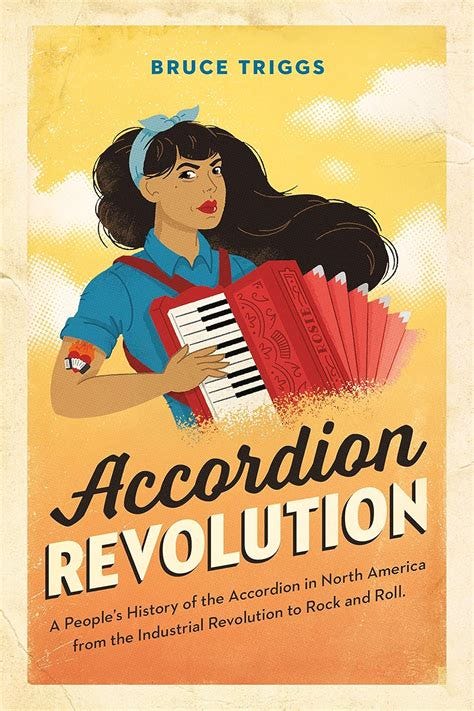
And check out Triggs’s Etsy shop. (I love the accordion stickers that read “one less guitar.”) Full disclosure: I copy edited his book, perhaps the most synergistic freelance gig I’ve ever been randomly assigned.
I’ve played accordion since high school — willingly. I was a piano player who wanted to busk. My German friend had been forced into lessons since he was barely bigger than the instrument himself; he had an extra one, and loaned it to me permanently. I’ve been forever in debt to him ever since.
Most music writers pretend to be cool, at least in the early stage of their career. I could never claim to be cool — because I played the accordion. It was my armour against surrendering to snobbery.
Please enjoy my personal accordion porn. These are my current babes:
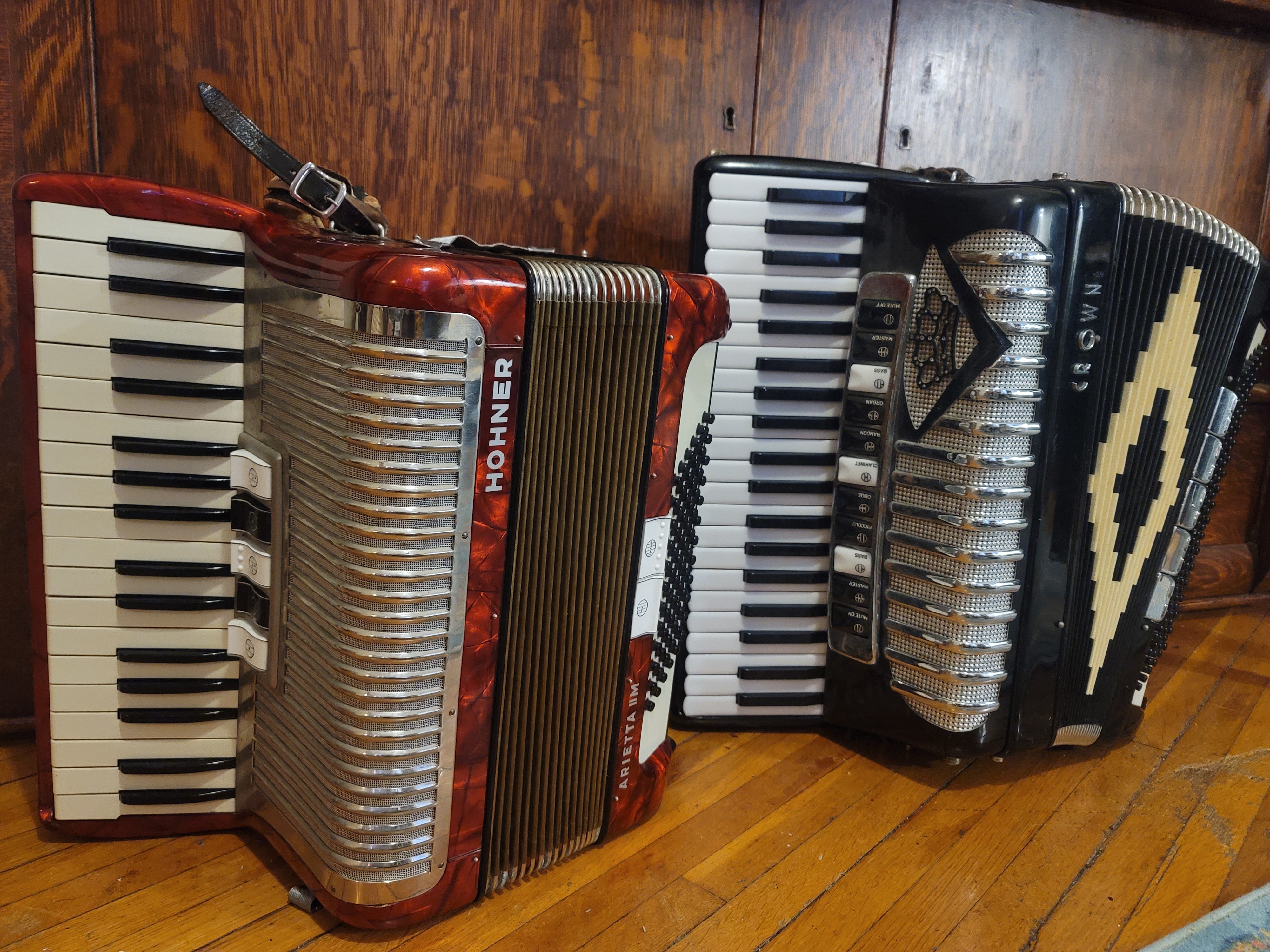
I played accordion in a rock band that toured Canada and made records in the ’90s — not a popular time for the accordion, Krist Novoselic notwithstanding:
These days I squeeze my box mostly at the Tranzac’s monthly klezmer jam (where I’m usually one of at least three accordionists).
My whole adult life I’ve been asked: why the accordion?
I grew up in the 1980s, and yes, I had friends who were super into “Weird” Al Yankovic. Maximum respect to that guy, who still has game: his music directly inspired one of my teenager’s best friends to take lessons, which I found kind of shocking in 2026. (That kid is now a metal drummer: go figure.) But I was/am a mild “Weird” Al fan at best — and the fact he played accordion was part of the whole joke.
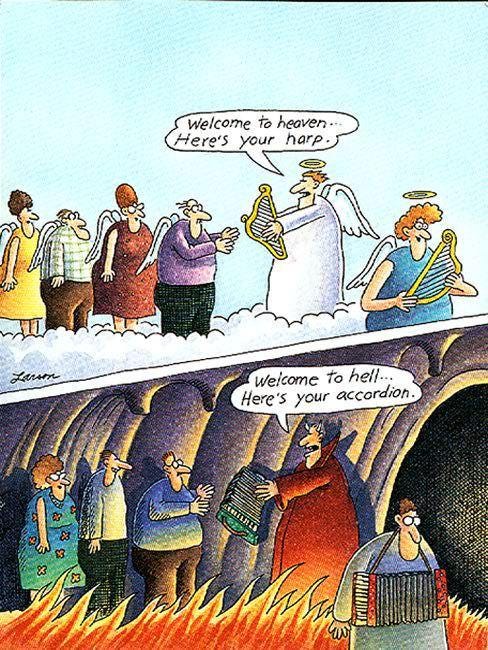
Accordions not only sound amazing — OBVIOUSLY — but to teenage me they symbolized the opposite of the ’80s synth revolution. Don’t get me wrong, my life was changed by Yazoo and I went to see Kraftwerk last year. But nothing, to me, beats an accordion.
I didn’t come to the instrument through folk music; I grew up in Scarborough, a suburb of Toronto that homeboy Mike Myers captured accurately in Wayne’s World. I was surrounded by metal and hip-hop. I came to the accordion through pop, rock and new wave music — which, counterintuitively, the instrument was not that unusual in the 1980s.
Going to guess my first exposure was the closing track on my favourite childhood album:
In theory, the accordion was uncool for new wave preppies who listened to CFNY. But in reality, it was always around:
It featured prominently on the lead single from the first Talking Heads cassette I bought:
In 1986, Paul Simon’s Graceland became one of the biggest albums of the decade, in part because the sounds were so alien to Western ears (that’s a whole other essay). What’s the first sound on the album? An accordion part that I’ve tried to learn over the years, and find near-impossible to replicate:
My introduction to “Americana” or what was then called “roots rock” was through Los Lobos, pre-“La Bamba.” I loved those first two albums, in part because, to my surprise, they always included a couple of Mexican polkas, which totally ripped. I haven’t met a lot of my musical heroes, but backstage at Hillside one year I did get to awkwardly tell David Hidalgo how inspiring he was. He nodded graciously and took another bite of sausage.
The Pogues were everything to my circle of friends at high school, each for our own reasons, but for me it was the absolute wizardry of James Fearnley, who would leap around with this giant suitcase of an instrument and manage to play fiery parts while sometimes covered in silly string:
Fearnley wrote a very good memoir about his time in the band. Accordionists are good writers — who knew? Plus, he made “London Calling” and “Honky Tonk Women” sound even better.
Los Lobos introduced me to Mexican music and the Pogues to Irish music, but there was also a weird moment in the ’80s when zydeco came into fashion: it also played a small role on Graceland, but it was largely through The Big Easy soundtrack, particularly Buckwheat Zydeco. I saw the New Orleans legend once, at the Horseshoe, and finally understood how guitar players felt watching Eddie Van Halen.
The only American rock band that truly mattered to me in high school was R.E.M. Naturally, Mike Mills picked up an accordion for the most beautiful song on their major-label debut:
But even the synth bands wrapped their arms around a squeeze box on occasion. Like the Cure’s “How Beautiful You Are,” or this total banger from Siouxie and the Banshees (“wind bag” break at the 1.15 mark)
Because of the nerdy crowd I ran with, I was not unaware of They Might Be Giants, who were a gateway drug into accordion for many of my peers. Here they are on The Tonight Show:
Here in Canada, Blue Rodeo’s Bob Wiseman was already the most exciting keyboard player around, and became even more bedazzling when he picked up an accordion on 1989’s Diamond Mine (solo at 1.20 mark):
He also played it on his solo records, wielding it on his one and only song that could have been a pop hit (and was a CBC-TV show’s theme song for a while):
Then there was Linda McRae of Spirit of the West, who shreds on this song that is now a Canadian classic and wedding dancefloor staple, but wasn’t even a single at the time:
None of the above examples, other than Paul Simon, were heard on mainstream pop or rock radio at the time. But there was one American rocker who put accordion front and centre at the height of his stardom: John Mellencamp. I got to see this tour at Maple Leaf Gardens, and loved this song so much — perhaps the only song on Q107’s playlist with accordion — that, yes, I did quote the chorus in my high school yearbook. A few years later I was in my own rock band, playing accordion alongside a violin player — though I didn’t make the conscious connection until years later.
It’s no surprise, then, that one of the many, many reasons I fell in love with Arcade Fire in 2003 was because they too had accordion and violin front and centre — making them the first great rock band since Mellencamp’s to fully realize their potential as rock instruments.
I’m focusing this post on the 1980s, so I won’t get into every accordionist I’ve ever loved across all genres. But special mention must go to Vancouver’s Geoff Berner, one of my favourite singer-songwriters of the last 25 years, who just happens to be a solo accordion player:
(Berner hasn’t toured since the pandemic, but he is playing in Toronto on June 11 for the United Jewish People’s Order’s 100th anniversary, alongside Naomi Klein and Rae Spoon, at Trinity St Paul’s United Church.)
So squeeze on, accordion lovers. Text your friends and use the accordion emoji — which is a thing, and I use it all the time.
Love this piece! Viva L'Accordion!
Such a good read, Michael. I'm trying to finish up my next Substack right now; when I've done I'm gonna go back and play every single video you included!